Summary
What's the difference between catholic and christian
https://holylandmerchandise.com
What’s the difference between catholic and christian
The Great Schism of the Mind: Unraveling the Difference Between Catholic and Christian
It is a linguistic error that reveals a theological canyon. When someone asks, “Are you Catholic or Christian?” it is akin to asking, “Are you a Beagle or a Dog?”
To the logician, the question is flawed. A Beagle is a dog. A Catholic is a Christian. Catholicism is the original trunk of the Christian tree from which the Protestant branches later split. Yet, to the sociologist and the theologian, the question makes perfect sense. In modern parlance, “Christian” has become shorthand for “Protestant” or “Non-Denominational Evangelical,” while “Catholic” stands as a distinct cultural and theological entity.
To understand the difference, we must move beyond the surface level of statues and incense and touch the very bones of the faith. We must look at the Authority, the Salvation, and the Worship.
I. The Root of the Split: The Issue of Authority
If you want to understand why your Catholic neighbor prays to Mary and your Baptist cousin refuses to baptize an infant, you must look at the issue of Authority. This is the “Sola Scriptura” battleground.
The Protestant View (The “Christian” Stance): The Protestant Reformation of the 16th century was built on the cry of Sola Scriptura—Scripture Alone. For the non-Catholic Christian, the Bible is the sole, infallible rule of faith. If a practice or doctrine cannot be explicitly found in or logically deduced from the 66 books of the Bible, it is not binding on the conscience of the believer. The pastor has authority only insofar as he preaches the Word.
The Catholic View: Catholicism operates on a “Three-Legged Stool” of authority:
-
Scripture: The Bible (including the Deuterocanon/Apocrypha).
-
Tradition: The living transmission of the Gospel in the Church (teachings handed down from the Apostles that were not written, but lived).
-
The Magisterium: The teaching authority of the Church (the Pope and bishops), which interprets Scripture and Tradition.
The Expert Take: For a Protestant, the Bible is the judge of the Church. For a Catholic, the Church is the mother of the Bible (since the Church canonized the Bible in the 4th century). This is why Catholics accept dogmas like the Assumption of Mary, which are not explicitly in the Bible, while Protestants reject them.
II. The Mechanism of Grace: How Are We Saved?
If Authority is the brain of the divide, Salvation is the heart.
The Protestant View (Sola Fide): We are saved by Grace Alone through Faith Alone in Christ Alone. Good works are the fruit of salvation, not the root. You do not work to stay saved; you work because you are saved. The moment you believe, the righteousness of Christ is “imputed” (credited) to your account like a legal transaction. You are declared innocent.
The Catholic View: Catholics agree we are saved by Grace. However, they reject Sola Fide (Faith Alone). For the Catholic, salvation is a process, not just a one-time event.
-
It begins at Baptism (which washes away Original Sin).
-
It is maintained through Faith and Works (obedience).
-
It can be lost through Mortal Sin.
-
It is regained through Confession.
The Expert Take: Protestants view salvation as a courtroom verdict (Justification). Catholics view salvation as a hospital cure (Sanctification). A Protestant says, “I am covered in Christ’s robe.” A Catholic says, “I am being healed by Christ’s medicine to become holy.”
III. The Scandal of the Sacraments: The Eucharist
This is where the rubber meets the road on a Sunday morning.
The “Christian” (Protestant) View: For most Evangelicals, Communion (The Lord’s Supper) is symbolic. It is a memorial service: “Do this in remembrance of me.” The bread remains bread; the juice remains juice. It is a time to mentally reflect on the Cross.
The Catholic View: This is the source and summit of the Catholic faith. They believe in Transubstantiation. At the moment the priest prays over the elements, the substance of the bread and wine miraculously changes into the actual Body, Blood, Soul, and Divinity of Jesus Christ, even though the accidents (taste, smell, texture) remain bread and wine.
The Expert Take: To a Catholic, the Eucharist is the most intimate encounter with God possible on earth. To a Protestant, the Catholic adoration of the host looks like idolatry. To a Catholic, the Protestant communion service looks like a mere snack. This difference is profound and prevents open communion between the groups.
IV. The Communion of Saints and The Virgin Mary
Walk into a Catholic Cathedral, and you see statues. Walk into a Baptist church, and you see a pulpit.
The Protestant View: There is “One Mediator between God and Man, the man Christ Jesus” (1 Timothy 2:5). Praying to dead people is forbidden (necromancy). Mary was a blessed woman, a virgin who gave birth to Jesus, but she was a sinner saved by grace like everyone else. She has no power to hear or answer prayers.
The Catholic View: Death does not divide the Church. The “Church Triumphant” (in Heaven) is alive in Christ. Just as I can ask you to pray for me, I can ask Peter or Paul or Mary to pray for me. They are not dead; they are more alive than we are. Regarding Mary: She is the “New Eve.” She was preserved from Original Sin (Immaculate Conception) to be a pure vessel for God. We do not worship her (Latria), but we give her the highest honor (Hyperdulia).
V. The Afterlife: Heaven, Hell, and Purgatory
The Protestant View: Upon death, the soul goes immediately to either Heaven or Hell. “To be absent from the body is to be present with the Lord.”
The Catholic View: Heaven and Hell are realities. But what of the Christian who dies with minor unrepented sins or attachments to the world? They are not enemies of God (Hell), but they are not yet holy enough for the Beatific Vision (Heaven). Enter Purgatory. It is not a second chance at salvation. It is a state of purification—a “mud room” before entering the clean house of Heaven. It is painful, but hopeful.
VI. The Structure: The Church Visible vs. Invisible
The Protestant View: The “Church” is the invisible body of all true believers. Denominations are just organizational structures. There is no supreme earthly leader.
The Catholic View: The Church is a visible institution established by Christ on Peter (The Rock). It has a hierarchy: Pope, Cardinals, Bishops, Priests, Deacons, Laity. This unbroken line of authority (Apostolic Succession) guarantees the truth of the sacraments.
Conclusion: A House with Many Rooms
After 40 years of studying these differences, I have found that while the theological gaps are wide, the core remains the same. Both confess the Nicene Creed. Both believe in the Trinity. Both believe Jesus is God Incarnate, died for sins, and rose from the dead.
The difference lies in how that grace is accessed and lived out. The Protestant emphasizes the individual’s direct relationship with God through the Word. The Catholic emphasizes the communal journey of the Church through the Sacraments.
Are they different? Yes, vastly. Are they both Christian? Historically and theologically, yes.
The Great FAQ: 50 Questions People Ask About Catholics vs. Christians
I have scoured the top forums—Reddit, Quora, and Theological message boards—to find the most common, raw, and honest questions people ask. Here are the answers.
Category 1: Salvation & The Bible
-
Q: Are Catholics saved? A: Yes, if they trust in Jesus Christ as their Lord and Savior. Catholic theology affirms Jesus is the only way to salvation.
-
Q: Why do Catholics have a bigger Bible? A: Catholics kept the 73 books (including the Deuterocanon/Apocrypha) that were in the Greek Septuagint used by Jesus and the Apostles. Protestants removed 7 books in the 1500s to match the Hebrew canon.
-
Q: Do Catholics think they can buy their way to heaven? A: No. This is a misunderstanding of “Indulgences.” The Church condemns the selling of salvation (Simony).
-
Q: Why don’t Catholics memorize Scripture like Evangelicals? A: Historically, the Catholic liturgy (Mass) covers the whole Bible in a 3-year cycle. They focus on hearing it in worship rather than individual memorization, though this is changing with modern Bible studies.
-
Q: Do Catholics believe in being “Born Again”? A: Yes, but they believe it happens at Baptism, whereas Evangelicals believe it happens at the moment of “conversion” or the “Sinner’s Prayer.”
-
Q: Can a Catholic be a “Saved” Christian? A: In Protestant terms, yes. Many Catholics have a vibrant, personal relationship with Jesus.
-
Q: Why do Catholics rely on Tradition? A: They believe the Bible itself says to hold fast to traditions (2 Thess 2:15) and that the Bible ultimately came from Church tradition.
-
Q: Do Catholics believe the Bible is inerrant? A: Yes, regarding matters of salvation and faith.
-
Q: Why is the Catholic Mass so repetitive? A: It is meant to be meditative and biblical. Most of the prayers are direct quotes from Scripture.
-
Q: Do Protestants and Catholics read the same Ten Commandments? A: Slightly different numbering. Catholics combine “No other Gods” and “No Idols” into #1, and split “Coveting” into #9 and #10.
Category 2: Mary & The Saints
-
Q: Do Catholics worship Mary? A: Officially, no. They honor (venerate) her. Worship (Latria) is for God alone. However, to an outsider, the bowing and praying looks like worship.
-
Q: Why do Catholics pray to Saints? A: They view it as asking a friend to pray for them—a friend who happens to be in heaven and very close to God.
-
Q: Why do Catholics have statues? Isn’t that idolatry? A: They view them as “family photos.” They do not worship the plaster or stone; they use the image to recall the person represented.
-
Q: Do Protestants believe Mary was a virgin forever? A: Most do not. They believe she had other children with Joseph after Jesus (James, Jude, etc.). Catholics believe in her Perpetual Virginity.
-
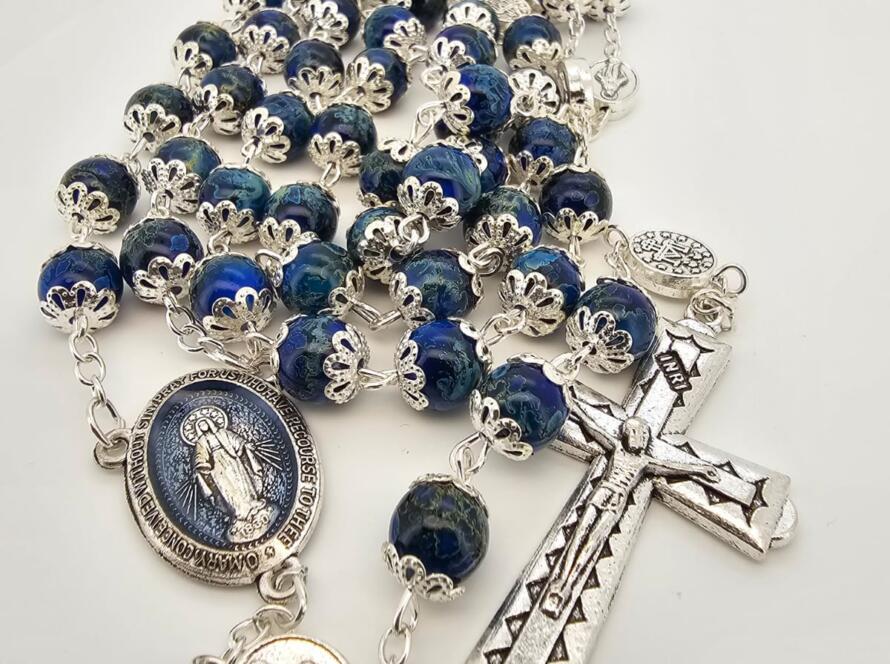
Q: What is the Rosary? A: It is a Scripture-based meditation on the life of Christ (The Mysteries), viewed through the eyes of Mary.
-
Q: Do Catholics believe Mary saves them? A: No. They believe Mary leads them to the Savior, Jesus. “Do whatever He tells you” (John 2:5).
-
Q: Why do Catholics call Mary the “Mother of God”? A: Because Jesus is God. If she is His mother, she is the Mother of God (Theotokos). It protects the divinity of Jesus.
-
Q: Do Protestants have Saints? A: Protestants call all believers “saints.” They do not have a canonization process for specific holy people.
-
Q: Why do Catholics carry relics (bones of saints)? A: Based on 2 Kings 13:21 (dead man coming to life touching Elisha’s bones) and Acts 19:11 (handkerchiefs touching Paul healing people). It honors the body as the temple of the Holy Spirit.
-
Q: What is the “Immaculate Conception”? A: Common mistake: It refers to Mary being conceived without sin, not Jesus (that is the Virgin Birth).
Category 3: The Pope & Church Structure
-
Q: Is the Pope the “Vicar of Christ”? A: Catholics say yes (he represents Christ on earth). Protestants say the Holy Spirit is the only Vicar of Christ.
-
Q: Is the Pope infallible? A: Only in very specific, rare circumstances when speaking ex cathedra on faith and morals. He is not impeccable (he can sin).
-
Q: Why can’t Catholic priests marry? A: It is a discipline, not a dogma (Peter was married). It allows the priest to be “married” to the Church and fully available to the people.
-
Q: Why do Protestants have so many denominations? A: Without a central authority (Pope) to interpret Scripture, disagreements on the text lead to new splits.
-
Q: What is the “Rock” Jesus built his church on? A: Catholics: The person of Peter. Protestants: Peter’s confession of faith (that Jesus is Lord).
-
Q: Why do Catholics call priests “Father” when the Bible says call no man father? A: Catholics interpret Jesus’ command as hyperbole against pride, citing that Paul calls himself a “father” to the Corinthians (1 Cor 4:15).
-
Q: Can women be pastors? A: In Catholicism, no (priesthood is reserved for men). In many Protestant denominations, yes.
-
Q: What is the “Magisterium”? A: The teaching office of the Church (Bishops and Pope) that guards the interpretation of Scripture.
-
Q: Do Catholics tithe? A: They are required to support the church, but the “10%” rule is less emphasized than in Evangelical circles.
-
Q: Can a Catholic Pope change the Bible? A: No. He is a servant of the Word, not above it.
Category 4: Rituals & Lifestyle
-
Q: Why do Catholics confess to a priest? A: Based on John 20:23. They believe the priest acts in persona Christi (in the person of Christ) to facilitate forgiveness.
-
Q: Why can’t Protestants take Catholic Communion? A: Because taking Communion implies you agree with everything the Catholic Church teaches (especially Transubstantiation).
-
Q: Why do Catholics baptize babies? A: They view baptism as the New Covenant equivalent of Circumcision (Colossians 2), replacing the old sign which was applied to infants.
-
Q: Do Protestants have “Holy Water”? A: Generally, no.
-
Q: Why do Catholics make the Sign of the Cross? A: It is a physical prayer invoking the Trinity and recalling the price of salvation.
-
Q: What is Lent? A: A 40-day season of fasting and repentance before Easter. Some Protestants observe it, but it is central to Catholicism.
-
Q: Why do Catholics have crucifixes (Jesus on the Cross) instead of empty crosses? A: To remind them of the suffering and sacrifice (“We preach Christ crucified” – 1 Cor 1:23). Protestants prefer the empty cross to emphasize the Resurrection.
-
Q: Can Catholics get divorced? A: Civil divorce, yes. But religiously, they must get an “Annulment” (declaring the marriage was never valid) to remarry in the Church.
-
Q: Why do Catholics stand, sit, and kneel so much? A: It is “active worship,” involving the whole body in prayer.
-
Q: What is “Last Rites”? A: Prayers and anointing given to the dying to prepare their soul for judgment.
Category 5: Social & Cultural Issues
-
Q: Are all Catholics against birth control? A: Officially, yes (Humanae Vitae). Many Protestants accept contraception.
-
Q: Why do Catholics have fish on Fridays? A: It is a penance. Giving up warm-blooded meat to identify with Christ’s sacrifice on Good Friday.
-
Q: Are Charismatic Christians Catholic? A: There is a “Catholic Charismatic Renewal” movement that worships similarly to Pentecostals.
-
Q: Who has the “correct” Bible? A: It depends on who you ask! Catholics claim the original; Protestants claim the purified.
-
Q: Do Catholics believe in the Rapture? A: No. They believe in the Second Coming, but not the “Left Behind” style secret rapture theology common in Evangelicalism.
-
Q: Can a Catholic go to a Protestant church? A: They can visit, but it does not fulfill their “Sunday Obligation” to attend Mass.
-
Q: Why is the Catholic Church so rich? A: It owns priceless art and real estate accumulated over 2000 years, but most “wealth” is in historical assets that cannot be sold, and many dioceses are actually cash-poor.
-
Q: Do Catholics drink alcohol? A: Yes. They believe in moderation, not prohibition. Jesus turned water into wine, after all.
-
Q: What is “Confirmation”? A: A sacrament where a baptized person claims the faith for themselves and receives a special outpouring of the Holy Spirit.
-
Q: Will Catholics and Protestants ever unite? A: We are united in baptism and belief in Christ, but institutional unity is unlikely until Jesus returns due to the doctrinal differences on Authority and Eucharist.